When things get too deep, people drown
I’ve never been a big fan of “sharing” small groups, so I thought this was pretty funny:
H/t: Byzantine, TX
I’ve never been a big fan of “sharing” small groups, so I thought this was pretty funny:
H/t: Byzantine, TX
Opus Dei is again in the press, this time because of the release of the movie There Be Dragons, which is somewhat based on the life of Opus Dei’s founder, St. Josemaría Escrivá. Whenever Opus Dei comes up, it seems that strong opinions and even controversy is sure to follow. Some of this is understandable – after all, any organization that quickly grows and becomes as influential as Opus Dei is sure to attract both strong friends and enemies – but some of it is also laughable for those who even have an inkling of knowledge of the group. But one thing I’ve noticed is how often in many minds the scandals involved with another Catholic movement – the Legion of Christ – have impacted Opus Dei.
The reason for this is due to the many similarities between Opus Dei and the Legion of Christ. A few include:
Because of these similarities, these two organizations have melded in many people’s minds almost into a single entity. So when the Legion faced serious scandals, some held Opus Dei in suspicion as well. I will admit to doing this myself. I personally have felt for some time that the Legion should be disbanded, and my strong feelings towards them seeped into my view of Opus Dei as well. I was suspicious that the failings of the Legion (which don’t just include the failings of its founder) were replicated by Opus Dei.
But over time I realized that my thoughts were an injustice to Opus Dei, which in fact is not in any real way related to the Legion. The similarities I mentioned above are superficial and none really relate to the Legion scandals. So to judge Opus Dei based on the sins of the Legion would be like judging Abel for the sins of Cain. And in fact, there is one big difference between the two organizations, which is:
The Legion of Christ doesn’t offer assassination training to its albino monks.
No, wait a minute, that’s not right (but realize that all articles on Opus Dei are required to have at least on albino monk joke). The real difference between the two groups is:
Opus Dei was founded by a canonized saint. The Legion of Christ was founded by one of the most notorious scoundrels who ever lived.
One cannot overemphasize this point too much. In the Catholic tradition, religious orders and movements are integrally linked to their founders. An authentic movement is faithful to its founder and keeps his or her spirit and teaching alive for future generations. In the case of Opus Dei, its founder has been officially recognized by the Church as living the faith heroically and in a way that can be imitated. In the case of the Legion, its founder has been recognized as a deceiver, an abuser, and an all-around scoundrel of the first order. Not exactly someone whose spirit we should keep alive, is it?
This of course does not mean that Opus Dei is for everyone or that its members have not sinned or done things at times improperly. But it does mean that as Catholics we should treat Opus Dei as we would the Franciscans or the Dominicans: as an authentic movement founded by a holy man whom we can look to as a heroic example of someone who lived the Christian faith well.
At a recent address on the liturgy, Pope Benedict said the following:
The liturgy, … lives a proper and constant relationship between sound ‘traditio’ and legitimate ‘progressio’, clearly seen by the conciliar constitution Sancrosanctum Concilium at paragraph 23. … Not infrequently are tradition and progress in awkward opposition. Actually though, the two concepts are interwoven: tradition is a living reality that, in itself, includes the principle of development, of progress.
This idea of the relationship – and tension – between tradition and progress has been a theme of Pope Benedict’s for his whole ecclesiastical career. We see it in his most recent book, Jesus of Nazareth: Holy Week, in which BXVI notes that Jesus himself was also a progressive traditionalist – adhering to the Law (“I have not come to abolish the law, but to fulfill it”), yet also taking no issue with going beyond calcified ideas of how to follow God.
This has been the great internal struggle of the past 100 years in the Church. The first half of the 20th century saw the end of an era in which the practice of the Catholic Faith had become stale and even ritualistic. Then Vatican II unleashed a host of forces which wanted “progress” simply for the sake of progress. Throughout his life, however, Pope Benedict has consistently urged a progressive traditionalism, in which we stay in continuity with the faith of our spiritual forefathers, yet develop it more deeply to address the issues of modern man. To the world, this makes him appear inconsistent: he was a “progressive” before Vatican II, and then a “traditionalist” after the Council. Yet it is BXVI who has been consistent while the world around him sways to the latest fad.
We too must strive to be progressive traditionalists. We do not want change simply because the world demands it, yet we also should not be reactionaries who simply reject change because some want it. Instead, like Pope Benedict (and like Jesus), we embrace our traditions, yet realize that they develop over time so that we can more deeply draw closer to our Lord.
Last Monday I spoke at a Theology on Tap in Alexandria, Virginia and had a great time. The crowd was very engaged, and they asked some great questions at the end of the talk. One of the questions was even from a young woman whom I taught 8th grade CCD back in the mid-90′s! (Yes, I felt old).
The Diocese of Arlington has put my talk online – you can download it here. Just find the picture of the really ugly guy and then click the Listen link underneath it.
Back in January 1994 I entered the M.A. in Theology program at Franciscan University of Steubenville. I was six months out of college, having gotten a B.S. in Systems Analysis at Miami University (Ohio). After a brief stint in a pro-life organization, I decided to return to school in a subject that I loved – theology. Little did I know that it would take me over seventeen years to complete the program.
Because my undergrad was unrelated to theology, I had to take almost all the prerequisites for the program. This meant taking six undergrad theology classes. For the next year and a half, I took these classes, along with four graduate foundations classes. During this time, I was the consummate bookworm. I often meet people today who attended Franciscan during the time I was there, but I neither remember them nor do they remember me. I literally had my head in a book more than 10 hours a day. Each day would run something like this:
During this time I also became engaged (why she wanted to marry such a bookworm was beyond me). Needless to say, we didn’t go out much.
But by Spring of 1995, I had run out of money and I didn’t want to get married and immediately get into wads of debt. So I made the hard decision to stop the program, still needing eight grad classes to finish. I moved to Maryland and got a computer programming job and hoped that it would be a minor pit stop before returning to the program.
And after two years, it appeared that I would go back to school. I got a job at a small (i.e. one-person) Internet company (before many knew what exactly the Internet was), and was allowed to move back to Steubenville and try to complete my degree while working from home. However, this was late 1997, right before the great Internet boom. The company I worked for went from 2 employees to 300 in less than two years, and I soon was managing a staff of 100 in Steubenville. Not surprisingly, I didn’t ever find time to actually take a class. After three years, I had given up my dream of a Master’s degree and decided to transfer back to the company’s headquarters in Maryland. However, things didn’t work out and I left the company to start my own software development company a few months later. Also, my wife and I continued to be blessed with children, which of course re-arranges one’s priorities very quickly.
During this whole time, however, I never lost my love of theology. I continued to read theological books in my free time, from authors such as Congar, de Lubac, von Balthasar, and Ratzinger. My time at Franciscan had introduced me to a whole world of brilliant theological minds which I couldn’t get enough of. I was especially thankful for Dr. Scott Hahn’s reading lists, which listed authors I had never heard of but were great thinkers and theologians.
I continued to work at my software company, but it always nagged at me that I had not completed my Master’s degree. I hate starting something and not finishing it. Then I discovered that I could take classes via distance education from Franciscan, and would not have to take any on campus since I had already taken all my foundational courses there. In 2007, although it had been over ten years since I left the program, I got special permission to start back up. So I began to take classes in my free time from home. For the next four years, I took my eight remaining classes (while writing two books). Finally, last Fall I finished my last class, and then took my comprehensive exams a few weeks ago.
Just today, I found out that I passed my comprehensive exams and completed my degree! I plan to go out to the graduation ceremony in May (ironically, the speaker at my graduation happens to be U.S. Representative Jeff Fortenberry, who was in the program with me in the mid-90′s [we even worked in the computer lab together]). How many people have their graduation speakers be someone they were in the program with?
I don’t usually write about my personal achievements on this blog, but I am very happy to have completed this degree so many years after beginning it and I wanted to share it with others. Praise be to God for giving me this wonderful opportunity!
The May 8th issue of OSV Newsweekly includes an article I wrote on how to respond when a loved one leaves the Church:
I had just finished a speaking engagement in a parish when a lady approached. She was in her late 50s, and seemed a bit apprehensive about speaking with me. After a few pleasantries, she came to her point: She was distressed because her two children — a son and a daughter — were no longer practicing Catholics.
She had been a faithful Catholic her whole life and simply didn’t understand how both of her children had turned their backs on their childhood faith. The two of them had taken very different paths away from the Church. Her son was now an evangelical missionary serving overseas, and her daughter was an agnostic with no interest in religion. She was slightly less concerned about her son, but clearly the abandonment of Catholicism by both troubled her deeply.
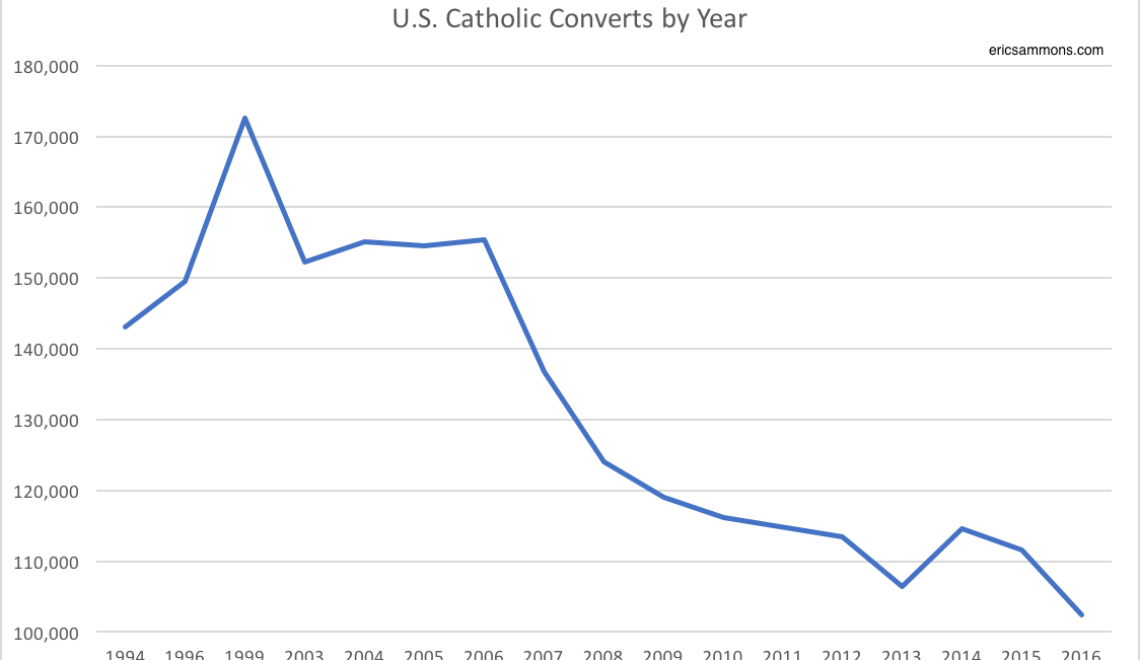
Unfortunately, this scenario is all too common today. In fact, I would estimate that this is the most common thing I am told by audience members when speaking to groups of Catholics. There are thousands of hurting Catholic moms and dads out there, begging God to bring their children back to the Church and dealing with immense feelings of guilt over the possibility that they are responsible for their child’s lack of faith. A recent Pew Research Center study found that 10 percent of all Americans — 10 percent! — are former Catholics. This makes former Catholics the third-largest “religious group” in the country behind Catholics and Southern Baptists.
So, what can a parent or sibling or cousin do to help his fallen-away family members return to the Church’s fold? Although individual situations are unique, there are some fundamental principles that we can follow to help the former Catholics in our families reconsider the Church.
In today’s first reading, we hear of Peter’s Holy Spirit-inspired preaching, and the effect it has on the people:
On the day of Pentecost, Peter said to the Jewish people, “Let the whole house of Israel know for certain that God has made him both Lord and Christ, this Jesus whom you crucified.” Now when they heard this, they were cut to the heart, and they asked Peter and the other Apostles, “What are we to do, my brothers?” (Acts 2:36-37)
Before we see what Peter’s response is, let’s look at a few things Peter did NOT say:
No, what Peter said was, “Repent and be baptized, every one of you, in the name of Jesus Christ for the forgiveness of your sins; and you will receive the gift of the holy Spirit.” (Acts 2:38). We must completely change the direction of our lives in order to be saved, and the only way to do this is through God’s grace, which is why baptism is necessary. During this Easter season, let us all renew our baptismal vows, repenting of the ways we have followed the wisdom of this world rather than the wisdom of the Holy Spirit.
For everyone in the Washington, DC area, I’ll be speaking at a Theology on Tap for the Diocese of Arlington next Monday. If you’re able to stop by, I’d love to say hello! Here are the details:
Topic: Defending Catholic Biblical Hermenuetics
Date: Monday, 5/2/2011
Time: 7:00pm
Location: Pat Troy’s Ireland’s Own
111 N. Pitt Street
Alexandria, VA 22314
Hope to see you there!
For years I have been a fan of alternative history – those fictional books which start with a premise such as “What if the South had won the Civil War?” or “What if Hitler had been assassinated in the 1920′s?” and then projects the “future” after that event. One of the values of these exercises is that it allows us to see how pivotal certain events in history are. So what about the most pivotal event in all of human history? What if Christ had not risen from the dead? What would the world look like?
Most importantly,
Praise be to God that, in the real world, His Son defeated death and raised gloriously to life on the third day. He is risen!

From an ancient homily for Holy Saturday:
The Lord’s descent into hell
What is happening? Today there is a great silence over the earth, a great silence, and stillness, a great silence because the King sleeps; the earth was in terror and was still, because God slept in the flesh and raised up those who were sleeping from the ages. God has died in the flesh, and the underworld has trembled.
Truly he goes to seek out our first parent like a lost sheep; he wishes to visit those who sit in darkness and in the shadow of death. He goes to free the prisoner Adam and his fellow-prisoner Eve from their pains, he who is God, and Adam’s son.
The Lord goes in to them holding his victorious weapon, his cross. When Adam, the first created man, sees him, he strikes his breast in terror and calls out to all: ‘My Lord be with you all.’ And Christ in reply says to Adam: ‘And with your spirit.’ And grasping his hand he raises him up, saying: ‘Awake, O sleeper, and arise from the dead, and Christ shall give you light.
‘I am your God, who for your sake became your son, who for you and your descendants now speak and command with authority those in prison: Come forth, and those in darkness: Have light, and those who sleep: Rise.
‘I command you: Awake, sleeper, I have not made you to be held a prisoner in the underworld. Arise from the dead; I am the life of the dead. Arise, O man, work of my hands, arise, you who were fashioned in my image. Rise, let us go hence; for you in me and I in you, together we are one undivided person.
‘For you, I your God became your son; for you, I the Master took on your form; that of slave; for you, I who am above the heavens came on earth and under the earth; for you, man, I became as a man without help, free among the dead; for you, who left a garden, I was handed over to Jews from a garden and crucified in a garden.
‘Look at the spittle on my face, which I received because of you, in order to restore you to that first divine inbreathing at creation. See the blows on my cheeks, which I accepted in order to refashion your distorted form to my own image.
‘See the scourging of my back, which I accepted in order to disperse the load of your sins which was laid upon your back. See my hands nailed to the tree for a good purpose, for you, who stretched out your hand to the tree for an evil one.
`I slept on the cross and a sword pierced my side, for you, who slept in paradise and brought forth Eve from your side. My side healed the pain of your side; my sleep will release you from your sleep in Hades; my sword has checked the sword which was turned against you.
‘But arise, let us go hence. The enemy brought you out of the land of paradise; I will reinstate you, no longer in paradise, but on the throne of heaven. I denied you the tree of life, which was a figure, but now I myself am united to you, I who am life. I posted the cherubim to guard you as they would slaves; now I make the cherubim worship you as they would God.
“The cherubim throne has been prepared, the bearers are ready and waiting, the bridal chamber is in order, the food is provided, the everlasting houses and rooms are in readiness; the treasures of good things have been opened; the kingdom of heaven has been prepared before the ages.”
![]()
One of the most profound insights from Pope Benedict’s Jesus of Nazareth: Holy Week is his meditation on the words of the crowd when they condemned Jesus to crucifixion: “His blood be upon us and upon our children” (Matthew 27:25). This passage has famously been used throughout history to condemn the Jewish race for the crime of deicide, but Benedict sees something far deeper at work here. Unlike the blood of other innocent men, it does not condemn, it redeems. The truth is that we all have his blood on upon us, for every time we sin, we crucify our Lord. But this is the blood of mercy, which cleanses us of our sins. This is the blood which Christ tells us we must drink or we do not have eternal life. This is the life-giving blood which pours out from the pierced side of Christ and forms the Church. This is the blood which is our salvation.
May it be upon us and upon our children.
![]()
(The following is from Who is Jesus Christ? Unlocking the Mystery in the Gospel of Matthew, pp. 133-134.)
In Acts, Luke relates that the Church in its earliest days was united in purpose and action:
They devoted themselves to the apostles’ teaching and fellowship, to the breaking of bread and the prayers.
— Acts 2:42
This description shows the vital relationship between the “breaking of the bread” and achieving true fellowship. As the Shepherd of the Church, Jesus has remained with his sheep, keeping them united in one flock, primarily through the sacrament of the Eucharist — the “breaking of the bread,” which is the sacrament of unity. The Eucharist binds the Church into a mystical communion that is impossible through any human means. Simply put, without the Eucharist, there is no Church: “The Eucharist makes the Church” (CCC 1395). Examining the history of the Church, one cannot but marvel that it still even exists today; the attacks from both within and without have been constant and, at times, brutal. From heresies arising from the bosom of the Church to persecutions launched by the state, the gates of hell have not relented in their assaults (cf. Mt 16:18). How could a purely human institution survive through the centuries against such opposition? But the Church has the benefit of a divine Shepherd who not only watches over his flock but gives his body as the very food by which it can remain united and strong.
From the very origins of the Church, her Eucharistic unity is clearly visible. St. Paul writes to the church in Corinth:
The cup of blessing which we bless, is it not a participation in the blood of Christ? The bread which we break, is it not a participation in the body of Christ? Because there is one bread, we who are many are one body, for we all partake of the one bread.
—1 Cor 10:16-18
It is through participation in the Eucharist that Christ’s followers become more than just a likeminded group of people — they become one body. The Eucharist unites the Church to the saving act of Jesus on the cross, making her part of the world’s redemption.
The Eucharist binds its recipients not only to the Lord but also to each other. In a very real way, the bond a partaker of the Eucharist has with his fellow communicants is deeper than that of flesh and blood. Biological unity is of the flesh, but Eucharistic unity is of the Spirit of God. Christ said in his Eucharistic discourse, “It is the spirit that gives life, the flesh is of no avail” (Jn 6:63). Each member of the Church is a true brother and sister in the Lord, and the Church is the family of God. A family may have arguments or disagreements, but nothing can make two of its members cease to be part of the same family. Likewise, the Church cannot be divided as long as it is united in the Eucharist.
Bryan Kemper, a long-time pro-life leader who founded both Rock for Life and Stand True Ministries, recently announced on his website that he has decided to join the Catholic Church:
My Journey Home To The Catholic Church – Why I Am Converting To Catholicism
Dear friends,
I know this may come as a shock to many of you; I am in shock in a way my self. I have spent the past 23 years living my life for Christ always wanting to serve Him and know His truth.
I have been a member of the Orthodox Presbyterian Church for almost 10 years as I was so inspired by the liturgy and reverence I found there. I have also been in a constant journey for God’s truth, studying His Word as well as church history. After many, many years of resisting a calling that I tried to suppress I have finally felt the peace of God with my decision to join the Catholic Church.
I know that many of you will be confused, even concerned for me. I know that you will have many questions and even be tempted to try and dissuade me from this decision. While I will most certainly talk to you about what God is doing here, I will not be entering into any debates about this right now.
I want to let you know this is not made lightly; I fought against this for years. There are several things that led me to search and finally choose to go back to the Church. I will share a few things in brief here and would love to sit down in person some time with you if you want to peacefully discuss them in more detail.
As a fellow pro-life Protestant Christian who came home to Rome, I can’t be happier for Bryan. Welcome home!